
The Berkshire Bike Path is within reach, and might look different than what you imagine

by Nick Russo, Senior Transportation Planner

The idea of a continuous, connected, low-stress bicycling route through Berkshire County has persisted for decades. Connecting our major town and village centers with a real cycling option would provide an alternative to the notorious congestion and parking crunch in the summer months and would lower the cost of transportation for workers and shoppers.

After getting a unique opportunity to visit continental Europe this summer and cycle over 160 miles around southern Germany and the Netherlands, there were many examples that stood out to me for what could be brought back to the Berkshires. Solutions that we may not have considered as thoroughly up to this point should be worked into the Berkshire Bike Path plan. These include (1) regionwide bicycle wayfinding systems, (2) a reimagining of how the highway right-of-way could be allocated for driving, cycling, and walking, and (3) smart ways of sharing existing streets where appropriate.
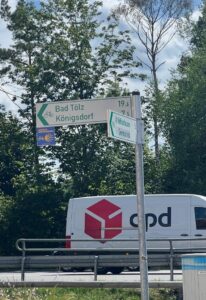
Wayfinding signs in Germany indicating direction and distance for cycling destinations.Wayfinding signs in the Netherlands indicating direction and distance for cycling destinations.


Wayfinding signs in Germany (left) and the Netherlands (right) provided guidance and reassurance while navigating on both rural country roads and dense urban cities.

Navigating around Berkshire County by bike can be different than by car. With e-bikes now a staple offering at most bike shops, the Berkshire Hills need no longer be seen as a barrier for cycling in the region. And trust me, from my experience – climbing a hill with or without an e-bike on a safer, quieter back road or separated bike path just feels easier than hugging the shoulder on a main highway with traffic whizzing past. Navigating the back roads of Berkshire County can be a relatively easy venture with a robust system of wayfinding. In my travels in Europe, nearly every junction along the designated cycling network had a guide sign to keep me going in the right direction.
Addressing Alcohol Misuse and Addiction in Berkshire County

Throughout the Berkshires, local health experts increasingly note the urgency of reducing alcohol misuse. The pervasive normalization of alcohol has a strong impact on youth, who report their own use is influenced by attitudes and expectations set by adults (“peer pressure” appears to play a lesser role).

Nationally, alcohol misuse is responsible for approximately 178,000 deaths per year; by comparison, in 2022 drug overdoses accounted for 110,000 deaths. In 2023, 22% of  County adults reported binge or heavy drinking, above state and national averages of 19%. Data from Berkshire Health Systems shows that

The Opioid Crisis and Berkshire County

Berkshire County continues to take enormous strides to combat the opioid crisis, including an extensive history of proactive practitioner education around pain management, more and more providers able to prescribe buprenorphine, and an increase in harm reduction, recovery, and treatment resources available despite the pandemic. In light of this extraordinary work, it was disheartening to see 62 opioid overdose deaths reported last year, up 11% from the year before and the highest number of recorded deaths.

Funding Open Space, Trails and Active Transportation Across the Commonwealth

Funding Open Space, Trails and Active Transportation Across the Commonwealth
On December 16, 2021, various state agencies held a webinar titled “Funding Open Space, Trails, and Active Transportation Across the Commonwealth.” The Appalachian Mountain Club’s Kristen Sykes hosted and moderated the meeting.

Modern Roundabouts in the Berkshires

Modern Roundabouts in the Berkshires

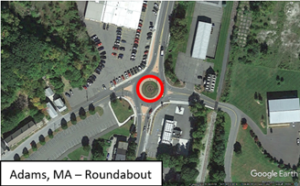
In October 2021, the City of Pittsfield’s first-ever modern urban roundabout became operational at Tyler Street and Woodlawn Ave. The only other modern roundabout currently in the Berkshires is in Adams, constructed in 2016 on Route 8 by the Massachusetts Department of Transportation. Pittsfield’s roundabout is built entirely on city-owned roads in one of the densest neighborhoods of the city: no small feat.

Census 2020

The Census Bureau has released the initial results from the 2020 Census. The official population for Berkshire County in 2020 was 129,026. This population represents a loss of 2,193 people since 2010 or -1.7%. The Census Bureau had estimated that the county’s population would drop to below 125,000, so the region did substantially better than estimated.

Preparing for the Future of Work in the Commonwealth of Massachusetts

New Report Charts Path for the Post-COVID Commonwealth Workplace

A July 2021 study commissioned by the Baker-Polito administration, Preparing for the Future of Work in the Commonwealth of Massachusetts, seeks to help town leaders understand how workplace shifts begun during COVID-19 could impact their communities in years to come.  Conducted by McKinsey & Company, the report explores near- (2025) and long- (2030) term trends and suggests how towns can prepare for them to support residents’ and economies’ success.

Berkshire County Education Task Force (BCETF) Secures Funding

The Berkshire County Education Task Force (BCETF) is pleased to announce that it has secured funding from the Massachusetts Department of Elementary and Secondary Education and the Barr Foundation to continue efforts into 2021 and 2022.   BCETF is a non-partisan group of committed community members dedicated to strengthening public education in Berkshire County, in light of shrinking enrollment, stretched resources, and constrained educational opportunities.  

Marijuana Delivery Update 2021

On November 30, 2020 the Cannabis Control Commission (CCC) voted 3-1 in favor of creating two classes of adult-use marijuana delivery licenses. These regulations were promulgated on January 8, 2021. Previously, Marijuana Transporters were utilized to transport, temporarily store, sell, and distribute marijuana from one marijuana establishment (ME) or medical marijuana treatment center (MTC) to another. The newly enacted legislation permits the delivery of marijuana and marijuana products directly to the consumer’s residence.